
Rethinking Manager Development: Learning for How Managers Actually Work
Feb 18, 2026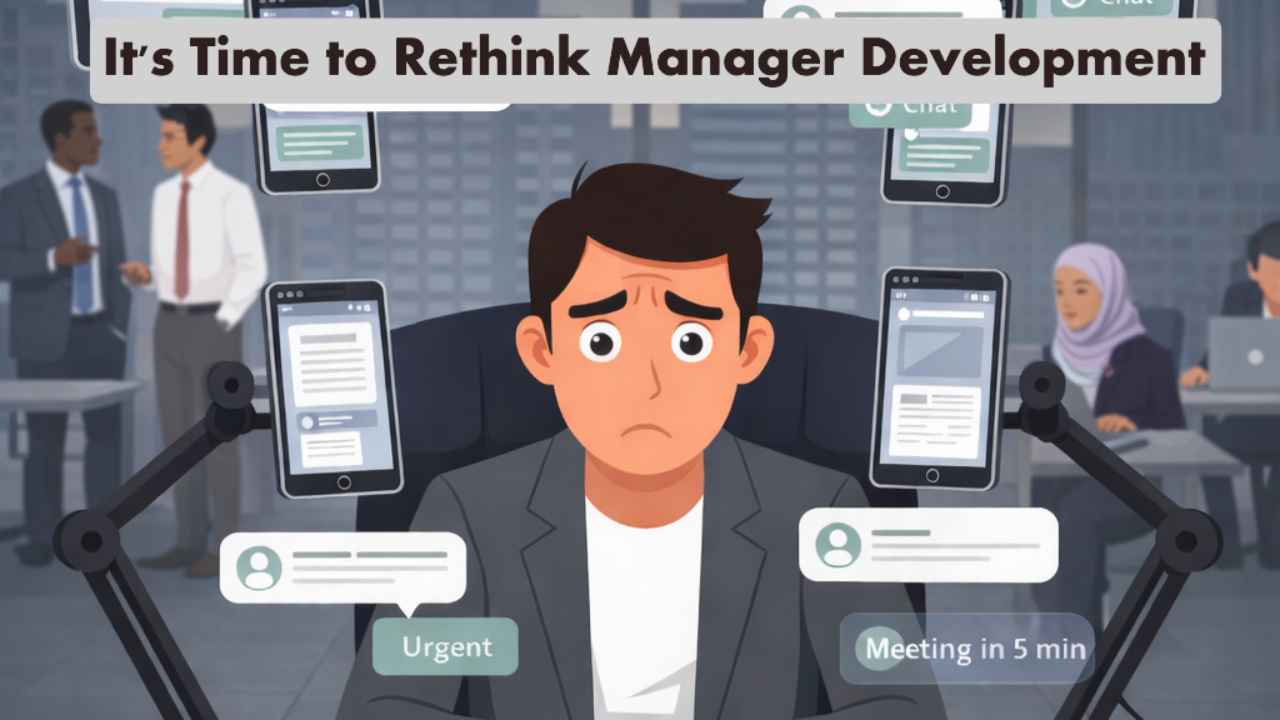
Most organizations agree on one thing: the job of a manager has changed dramatically over the last few years.
Managers today are dealing with more meetings, more tools, more digital noise, more ambiguity, and now, the added complexity of AI. Despite these changes, manager development programs have not evolved as much as the role itself.
This mismatch is becoming increasingly apparent.
The Need for Change in Manager Development
Traditional manager development programs are well-intentioned and often well-designed. However, many are based on assumptions that no longer fit the reality of a modern, AI-powered workplace. To help managers succeed now and in the future, we must reconsider not only what we teach, but how manager capability is actually built.
The Old Assumption: Teach the Skill, Managers Will Apply It
For decades, manager development was rooted in the belief that teaching managers the right skills would enable them to apply those skills on the job.
Curricula were designed around communication, feedback, coaching, performance management, and engagement. Workshops were held, frameworks delivered, and scenarios practiced, all with the expectation that these skills would translate back into the workplace.
In a slower, simpler workplace, this approach was effective.
Today, managers operate within complex systems—calendars filled with meetings, conversations across chat and email, decisions made asynchronously, work scattered across tools, and constant context switching.
The gap between learning and doing has never been wider.
What Traditional Manager Development Looks Like
Most traditional manager curricula are structured around content and events rather than work.
A typical curriculum might include:
- New manager foundations
- Communication or feedback training
- Performance management workshops
- Coaching or engagement programs
These experiences are valuable, but they largely take place outside the manager’s daily workflow. They assume managers will integrate what they've learned into practice on their own, during an already overloaded workday.
Two things are missing. First, embedding the topics into work. For instance, a manager preparing for a performance feedback conversation should be able to practice and receive feedback in the systems they use, in the moment. Second, there is a lack of teaching on how to work. Managers often lack a clear understanding of how information and actions move through the organization to accomplish tasks. While there are many new tools, there are no systems for operating effectively as a manager.
The result is that even strong skills tend to decay under pressure.
Why the Old Model Breaks Down
The challenge managers face today is not a lack of motivation or intent; it is fragmentation.
Work happens everywhere—across meetings, messages, documents, and tools. Decisions are made but may not stick. Action items are captured but often not followed through. Training occurs somewhere else entirely.
This is why traditional workshops often fail to transfer effectively. The learning is abstract, yet the work is highly contextual.
At this point, AI becomes a double-edged sword.
AI can support managers by summarizing information, drafting content, surfacing insights, and reducing administrative burden. However, without clear structure, AI does not solve chaos—it accelerates it.
A New Assumption: Manager Capability Is Built Inside the Work
If the old assumption was “teach the skill and hope it shows up,” the new assumption is:
The fastest way to develop managers is to improve how their work actually runs.
Managers need not just better judgment but better systems. They require clear workflows, shared operating habits, and simple, repeatable ways of running work that make good behavior the default.
In this model, development occurs not before or after the work, but inside the work:
- While preparing for a 1:1
- While running a meeting
- While launching or tracking a project
The work itself becomes the mechanism for learning.
From Curriculum as Content to Curriculum as Workflow
This shift fundamentally alters what a manager development curriculum looks like.
Instead of organizing development around courses and competencies, it is centered on the core workflows managers run every week:
- How 1:1s actually work
- How meetings produce decisions and follow-through
- How projects launch, execute, and stay on track
People skills, process discipline, and technology support are developed together—not separately. AI becomes a powerful accelerator within a well-designed system, rather than a shiny add-on.
What Comes Next
Rethinking manager development at this level brings up important questions:
- How do you identify the right workflows to focus on?
- How do you design them so managers actually use them?
- How do you integrate AI and tools without overwhelming people?
- How do you reinforce these habits over time?
These “how” questions are where the real work—and opportunity—begins.
In an upcoming recorded session, I’ll present a practical, step-by-step approach to redesigning manager development around workflows, context-based learning, and AI-enabled execution—using real examples from the modern workplace.
If you’re responsible for developing managers and feel the gap between training and reality widening, now is the right time to rethink the model.
The tools have changed.
The work has changed.
It’s time manager development caught up.